Growing Up on Maple Street
Chapter 1: The House on Maple Street
The Beginning
I don't remember being born, of course. Nobody does. But I've been told the story so many times that it feels like a memory: October 15th, 1952, St. Mary's Hospital, a cold autumn morning with leaves swirling in the parking lot. My mother said I came into the world screaming—"Like you had opinions already," she'd laugh—and my father said he knew right then that I was going to be a handful.
They brought me home to the house on Maple Street three days later. That house—a modest two-story with white siding and black shutters—would be the backdrop for my entire childhood, the stage where all my early memories would play out.
The House
The house on Maple Street wasn't grand. It had three bedrooms, one bathroom, a kitchen that was always too small, and a living room that somehow accommodated our entire extended family every Thanksgiving. But to me, it was a mansion, a fortress, a universe unto itself.
My bedroom was on the second floor, the smallest of the three bedrooms, with a window that looked out over the backyard. I spent countless hours at that window, watching the seasons change: the maple tree (for which our street was named) bursting into green each spring, providing shade in summer, blazing orange and red in fall, standing bare and dignified in winter.
The backyard was my kingdom. It wasn't large—maybe thirty feet by forty—but it contained multitudes. There was the sandbox my father built when I was three, which later became a garden when I outgrew it. There was the tire swing hanging from the maple tree, which my brother and I fought over constantly. There was the small vegetable patch where my mother grew tomatoes, peppers, and beans, teaching me early that food didn't just come from stores.
The Neighborhood
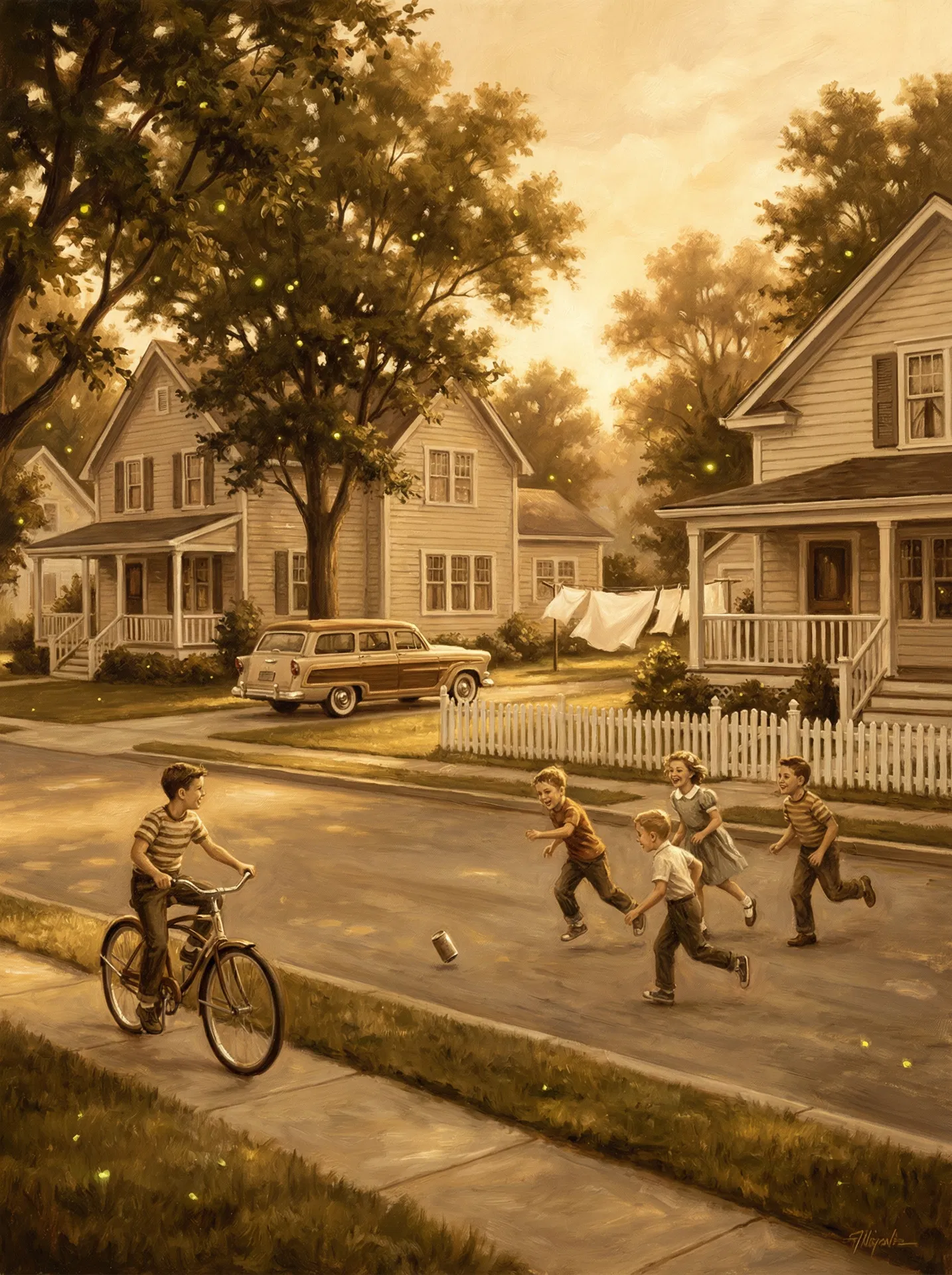
Maple Street in the 1950s was the kind of place that exists now mostly in nostalgia and black-and-white photographs. Everyone knew everyone. Doors were left unlocked. Kids played in the street until the streetlights came on, and that was the signal to head home for dinner.
The Johnsons lived next door. Mr. Johnson worked at the factory, and Mrs. Johnson made the best chocolate chip cookies in the neighborhood—a fact I knew because she'd give me one whenever I helped her carry in groceries. Their son, Tommy, was my age, and we were inseparable from the time we could walk.
Across the street were the Hendersons. Mrs. Henderson was a widow who'd lost her husband in the war. She had a garden that was the envy of the neighborhood—roses, tulips, daffodils, something blooming from early spring to late fall. She let me help her sometimes, teaching me the names of flowers and the patience required to make things grow.
At the end of the street lived the Patels, who'd moved from India in 1950. They were the first Indian family in our neighborhood, and I remember the whispers, the sideways glances. But Mrs. Patel made the most amazing food—spicy, aromatic dishes that were nothing like the meat-and-potatoes fare my mother cooked. She'd invite neighborhood kids over sometimes, teaching us about her culture, her country, her food. Looking back, I realize how brave they were, how much courage it took to build a life in a place where they were so visibly different.
Early Memories
My earliest clear memory is from when I was about three years old. It was summer, hot and sticky, and my mother had set up a small plastic pool in the backyard. I remember the shock of cold water, the way the sun made rainbows in the spray, the sound of my mother's laughter as I splashed.
I remember my fourth birthday party—a dozen kids crammed into our small living room, a chocolate cake with four candles, the thrill of blowing them all out in one breath. I remember the presents: a red tricycle, a stuffed bear, a set of blocks that I immediately used to build a tower taller than myself, then knocked down with glee.
I remember starting kindergarten at Lincoln Elementary, just three blocks from our house. I remember my mother walking me there that first day, holding my hand tight, trying not to cry. I remember Mrs. Patterson, my teacher, with her kind eyes and patient smile. I remember the smell of crayons and paste, the alphabet chart on the wall, the wonder of learning that those mysterious symbols could be decoded into words, stories, entire worlds.
Family Life
My father worked at the post office, a steady job that he held for thirty-five years. He'd leave every morning at 7 AM, lunch pail in hand, and return at 5:30 PM, tired but always ready to play catch in the backyard or help with homework or fix whatever had broken that day.
He wasn't a man of many words, my father. He showed love through actions: teaching me to ride a bike, building me a treehouse, attending every school play and baseball game. "I love you" wasn't something he said often, but I never doubted it. It was in every sandwich he made when Mom was sick, every bedtime story he read, every scraped knee he bandaged.
My mother was the heart of our home. She kept everything running—cooking, cleaning, managing the household budget, volunteering at church, organizing neighborhood events. She made it look effortless, though I understand now how hard she must have worked.
She sang while she cooked, old songs from her own childhood. She read to me every night, even after I learned to read myself. She knew all the neighbors' names, remembered their birthdays, showed up with casseroles when someone was sick or grieving. She taught me, by example, what it meant to be part of a community.
My brother, Michael, was born when I was five. I remember being excited about having a sibling, then quickly realizing that babies were boring. They couldn't play, couldn't talk, just cried and slept and needed constant attention. But as he grew, Michael became my best friend, my partner in crime, my constant companion. We fought, of course—over toys, over space, over nothing at all. But we also built forts together, created elaborate imaginary games, defended each other against neighborhood bullies.
The Rhythm of Life
Life on Maple Street had a rhythm, a pattern that repeated with comforting regularity. Weekday mornings meant breakfast at 7 AM—usually cereal or oatmeal, sometimes pancakes if it was a special occasion. School from 8 to 3. Homework at the kitchen table while Mom made dinner. Dad coming home at 5:30. Dinner at 6. Evening playtime in the backyard until dark. Bath, pajamas, bedtime story, sleep.
Saturdays were for chores in the morning—making beds, cleaning rooms, helping with yard work—and play in the afternoon. Sometimes we'd go to the park, or the library, or the five-and-dime where a quarter could buy a comic book or a bag of candy.
Sundays meant church in the morning, Sunday dinner at noon (always a big meal—roast chicken or pot roast, mashed potatoes, vegetables, pie for dessert), and quiet afternoons. Dad would read the paper. Mom would work on her knitting or mending. Michael and I would play quietly, knowing that Sunday afternoons were for rest.
The Seasons
Each season brought its own rituals on Maple Street. Spring meant cleaning—windows washed, carpets beaten, winter clothes packed away. It meant planting the vegetable garden, watching for the first robins, playing marbles in the dirt.
Summer meant freedom. School was out, days were long, and the neighborhood kids ran wild. We'd play kick-the-can until dark, catch fireflies in jars, run through sprinklers, have lemonade stands that rarely made more than a dollar but felt like successful businesses.
Fall meant back to school, new clothes, new teachers, new possibilities. It meant raking leaves into huge piles and jumping in them. It meant Halloween—costumes made from old clothes and imagination, trick-or-treating up and down Maple Street, coming home with pillowcases full of candy. It meant Thanksgiving, with the house full of relatives, the smell of turkey and pie, the kids' table where Michael and I sat with our cousins.
Winter meant snow—building snowmen, making snow angels, sledding down the hill at the park. It meant Christmas—decorating the tree, hanging stockings, the magic of Christmas morning. It meant hot chocolate and warm blankets, board games by the fireplace, the cozy feeling of being safe and warm while the world outside was cold and white.
Learning and Growing
Those early years on Maple Street were when I learned the fundamental lessons that would shape the rest of my life. I learned them not in school, but in the daily rhythms of family and neighborhood life.
I learned responsibility from my chores, from taking care of my little brother, from feeding the neighbor's cat when they went on vacation.
I learned community from the way neighbors helped each other—shoveling each other's sidewalks, sharing garden vegetables, watching each other's kids.
I learned resilience from scraped knees and hurt feelings, from learning to ride a bike and falling off a dozen times before I got it right, from losing games and trying again.
I learned creativity from the games we invented, the forts we built, the stories we told each other.
I learned empathy from Mrs. Henderson's sadness, from the Patels' courage, from seeing my mother comfort a grieving neighbor.
I learned love from my parents' daily devotion, from my brother's companionship, from the way our house was always open to friends and family.
The End of the Beginning
I lived on Maple Street until I was eighteen, when I left for college. By then, the neighborhood had changed. The Johnsons had moved away. Mrs. Henderson had passed. The Patels' children had grown up and moved to the city. New families had moved in, families I didn't know as well.
But those early years—those first memories—they stayed with me. They shaped who I became. The values I learned on Maple Street, the sense of community and connection, the understanding that home isn't just a place but a feeling—those things have guided me through every stage of my life.
When people ask me about my childhood, I always say the same thing: I was lucky. Lucky to grow up on Maple Street, in that house with the white siding and black shutters, with parents who loved me and a brother who drove me crazy and neighbors who looked out for each other.
That's where my story begins. That's the foundation everything else was built on. That's Chapter 1.
And what a chapter it was.