Crossing the Ocean
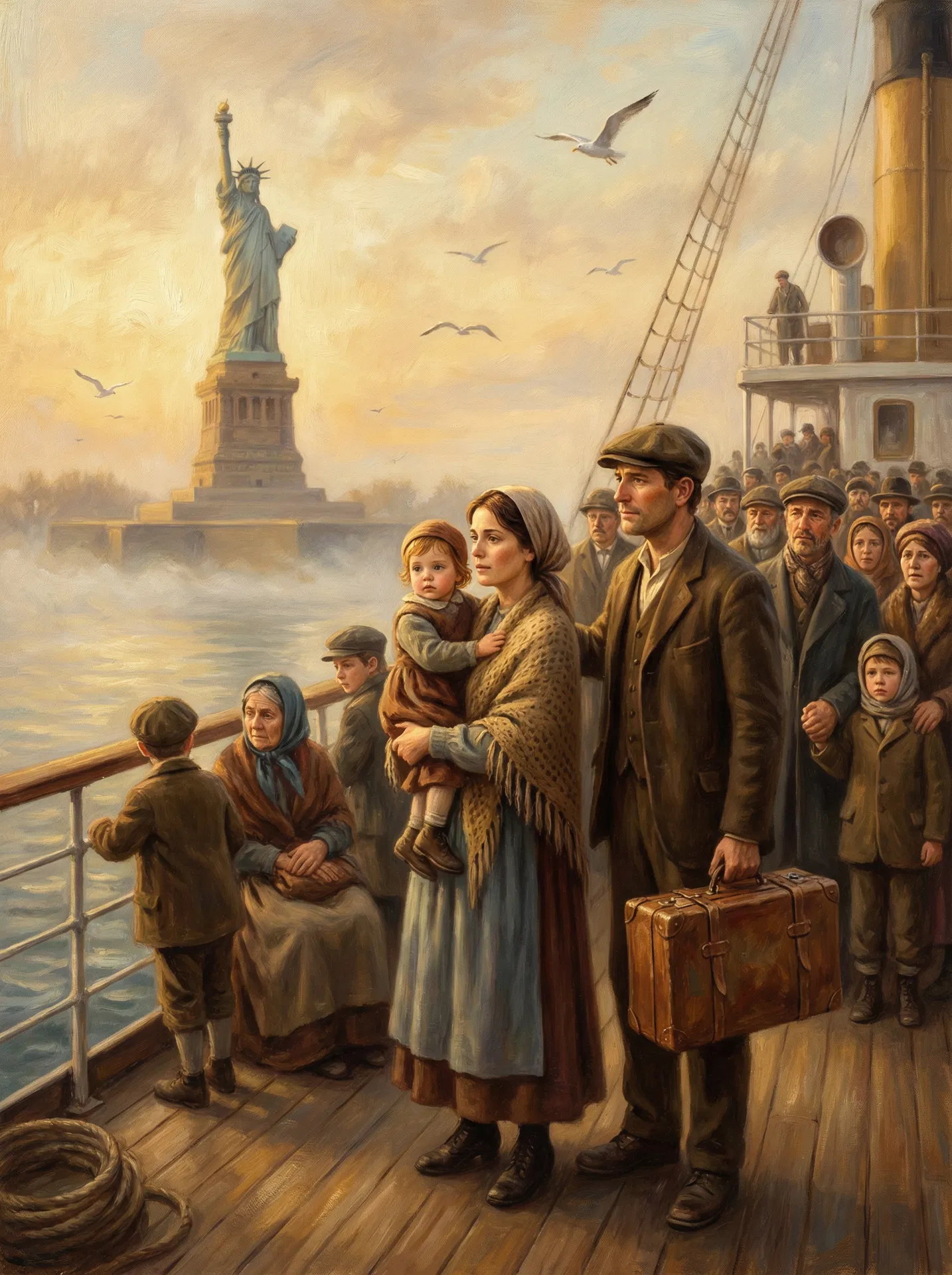
My mother never looked back. That is what I remember most clearly about the day we left—how she walked up the gangplank with her chin raised and her eyes fixed forward, as if looking back at the shore would turn her to salt.
I was seven years old. My father carried me on his hip because the crowd was thick. My sister Elena held our mother's hand and tried to look brave. The leather suitcase my father carried held everything we owned.
The crossing took eleven days. Our berth was in steerage—a vast, low-ceilinged space that smelled of engine oil and seasickness. My mother made a game of it, pretending we were explorers on a great adventure.
The morning we arrived, someone shouted from the upper deck. My father lifted me onto his shoulders and I saw her—the Statue of Liberty, enormous and green and impossibly beautiful, rising out of the morning fog like a promise made solid. Around us, people were crying and praying and embracing strangers.
My father, who had not cried when he said goodbye to his own mother knowing he would never see her again, wept silently with his hand over his mouth.
Ellis Island was chaos and confusion. We stood in lines for hours. When the man at the desk couldn't pronounce our surname, he shortened it, and just like that, with the stroke of a pen, we became someone slightly different than who we'd been.
Our first apartment was a two-room flat on Hester Street. The bathtub was in the kitchen. My mother hung a curtain to divide the sleeping area and declared it perfect.
But we learned. Children learn fast when survival depends on it. Within six months I could read English. Within a year I was translating for my parents. I became the bridge between their old world and this new one.
America was not the golden paradise my mother had described on the ship. It was hard and cold and sometimes cruel. But it was also vast and possible in ways the old country never was.
And every Thanksgiving, my mother would set an extra place at the table—not for a guest, but for the memory of everyone we'd left behind. She'd raise her glass and say: To those who stayed, and to those who had the courage to go.